|
Typhoon
race 2008 - Penghu, Taiwan The first pan Asia-Pacific F3F Tour, the Typhoon Race, was held in Penghu, Taiwan on Nov 7-9, 2008. 39 Pilots from Taiwan, Hong Kong, Australia and Japan gathered together in a small island at the west of Taiwan, sharing the thrill of F3F and the joy of friendship. (And the excellent seafood that won't drain your wallet. . . :D ) In the
beginning . . . F3F has been popular in Europe for many years. Rules, models and equipment are well established and competitions are being held in many countries. Among them the bi-annual Viking race is recognized as the world championship of F3F. In Asia, however, Taiwan was the only country that held slope racing annually for the local in the late 90's. Other than that, F3F or slope racing was even not known by many RC sailplane modelers in the region. Then in 2002, James Hammond (a British who lived and worked in Taiwan for many years) proposed to organize an F3F open competition in Kenting, Taiwan. It was called the Rimfire Race (for the Pacific rim area) and was planned to run in 2003. Pilots from all over the world are welcome to join. Unfortunately, due to the SARS outbreak and the other reasons, the Rimfire Race was finally cancelled. Despite of this, it ignited the light of F3F competition in the region. In the same year, a group of sailplane pilots in Hong Kong started slope racing. The first local F3F competition was held in 2002 by the Hong Kong Radio Control Soaring Society (HKRCSS). In the beginning both the models and equipment were primitive. Since then they learn the rules, refine the equipment and practice in every weekend. F3F competitions were held several times a year and they even joined the Viking Race 2004. It was in the VR04 that they first saw how an international F3F competition was run. It gave them hints and idea on the Hong Kong F3F Open 2005 that they were preparing. The first Hong Kong F3F Open was held in 2005. It is also the first F3F open competition in Asia. Pilots from Hong Kong, Korea and Taiwan joined the competition and a total of 8 rounds were run. Though the wind did not cooperate and the competition was finally called off on the third day, making the three days competition reduced to two, it is nevertheless a success. And the most important is the idea of F3F open competition spreading out to the other countries. Since the Hong Kong F3F Open 2005, there were the Taiwan F3F Open in 2006, the Korea and Hong Kong F3F Open in 2007. Here is a list of the F3F open competitions held in Asia-Pacific region previously: Hong Kong F3F Open 2005 http://www.hkrcss.org/HKF3F/HKOpen2005_report.html Taiwan F3F Open 2006 http://www.rcsail.com/taiwanf3fopen.html Korea F3F Open 2007 http://www.rcsail.com/koreanf3fopen.html Hong Kong F3F Open 2007 http://www.hkrcss.org/HKF3F/HKOpen2007_report.html During the Hong Kong F3F Open 2007, pilots from different countries sited together and agreed to consolidate all the open competitions of the region into one annual F3F competition – the Typhoon Race. It will be held by different countries in the area. The first one will be Taiwan and then Korea in 2009. Hong Kong and Australia are 2010 and 2011 respectively. Penghu -
The venue for Typhoon Race 2008 Penghu consists of several islands located at the west of Taiwan. It only takes about 20 minutes flight from any part of Taiwan to reach the islands. The most developed island is Magong which is where the airport and downtown are located. Other islands have fishing villages and resorts scattered around. Penghu is one of the resort areas in Taiwan famous of water activities. In autumn and winter, however, the islands became quiet because the north east monsoon brings strong wind and chilling air from the north. But it is also in this season we F3F fliers become HOT! The flying sites locate at the Siyu island, west of Magong. The "slopes" are cliffs of about 30m from the sea. As an island, there is always a suitable slope for virtually any wind direction. And as a coastal site, wind is consistent and thermal influence is not significant. Landing site is a flat field of grass larger than a football field. Can you ask for more? As for the accommodation, the Taiwan organizer did a great job. They booked an inn, and yes a whole four stories building for the competitors. So we lived together during the three days competition. Remember when you were young and went for camping with your buddies? That's exactly the same feeling! The
competition The first day's competition started with fine weather but light wind, which was a little out of our expectation. Wind did pick up a little in the afternoon, but not much. A round zero was provided for the pilots to familiar with the track and the buzzer. Round zero was not a compulsory, and one may choose not to take. The reason is that any penalty in round zero will also be counted in the finally score and so it is the pilots' decision to take the "risk" or not. Though you might think it should not happen, but actually Angus Lee and YC Lui from Hong Kong were deducted 100 and 200 points in round zero because they flew across the safety line! The Taiwan guys built a new timing gear this year. One of the favorite designs is the big LED panel that shows the flying time instantly. That really helps to boost the atmosphere. I only want it to be LCD because the LED is a little bit hard to read under bright sun light. Nevertheless it is one of the best F3F timers I have ever seen. Probably because of the weak wind and many were still new to the flying site, flying times in round one were not impressive. The average time was 68.09 seconds. Richard Frawley from Australia flew perfectly and took the 1000 points by a 57.31 seconds. In the second round the lift was improved. Many pilots got a better time than in the first round. Unfortunately, Richard crashed his Ceres because a servo locked out. The DNF put his leading position in a very dangerous place because he could not afford any fault in the coming rounds. In this round the 1000 points was taken by Cheung Wan-Kin from Hong Kong. The third round was also the last round of the first day's competition. This time Fujimuro Tetsur from Japan took the 1000 points. This is his 2nd time competed in Penghu. I must mention that his Skorpion is brand new and it had just completed its maiden flight one day before. Well done Fujimuro san! ********* After the first day's competition the leading were Chang Chi-Kang and Lin Kuo-Ping of Taiwan. Lin is the Champion of the Taiwan F3F league 2008. Chang is relatively fresh in F3F, but his talent in F3F started to show off since he joined the activity. He is not necessarily the fastest but his stable flying always put him in the leading positions. And this stable flying became his key to win when the conditions deteriorated considerably on the second day. On the second day we were greeted with strong wind, and rain! Rain was not heavy but it did rain for all the day. Well, for us F3F nuts we only concern about the water drops that add drag to our models, and damage to the radio gears. . . . That said, the Taiwan organizer was very kind and gave us rain coats and plastic bags to cover the models. Thanks! It was a little surprise to us that the flying location didn't change when the wind shifted north-easterly on the second day. It's really a great challenge: flying in rain and flying in 15m/s side wind. While the condition was more or less the same for every pilot, it can really separate the best from the average. Those who can read the air accurately and know his model completely can adopt his flying to cope with the changing condition, and get good result. In round 4 Cheung Wan-Kin finished in 48.08 seconds which granted him another 1000 points. It also turned out to be the fastest time in the competition. Lin Kuo-Ping and Mak Kai-Yeung (Hong Kong) followed by 48.36 and 50.44 seconds. Wan-Kin's "big circle" strategy seemed work good in the side wind condition: In the tail wind leg he flew high. Though the plane did not have the Split-S dive acceleration, speed could still build up because of the wind. In turning back to the head wind leg, he rolled the plane 180 degrees and pulled to dive to accelerate. The plane then flew in low altitude but with speed to break the head wind. Round 5 started with the wind shifted further to the north east. The head wind flying time was several times longer than in the tail wind leg. Many pilots made wrong decision in the turns and resulted in cuts and over-flown. And we can see in the final result, as the wind shifts further the average score becomes lower. Turn accuracy became crucial. In this round Cheung Wan-Kin took the 1000 points again by 49.22 seconds. Chang Chi-Kang lost by only a tiny bit of 0.04 seconds and became the second. What a pity! Richard was the third by 50.39 seconds. In round 6 the wind was nearly blowing from the right at 30 to 40 degrees. Average time increased to 65 seconds when it was 56 seconds in round 4. Although got a DNF in round 2, Richard managed to fly good and consistent in all the other rounds. In round 6 he got his second 1000 points. Flying time was 56.14 seconds. Jack Liao (Taiwan) and Hung Tsung-Yi (Taiwan) were 2nd and 3rd. Wind direction continued to shift and round 7 was cancelled just after a few runs when the wind was off the center by more than 45 degrees. It also ended the day's competition. Rain was getting heavier on the third day. The wind was strong and probably over the 25m/s upper limit. The organizer announced that there will be no flying in the morning and eventually it was called off in the afternoon as there was no sign to getting better. So a total of 6 rounds were flown in 2 days and the followings is part of the result:
Fastest Time: 48.08 seconds by Cheung Wan-Kin Team Champion: Wolf in Sheep (Lin Kuo-Ping, Lee Ping-Sang and Chang Chi-Kang) Complete result can be obtained from the Typhoon race 2008 official web site: http://www.typhoonrace.tw/ The title of Champion finally came to Chang Chi-Kang. He did not get a 1000 points during the 6 rounds, but his score never fall below 960 neither (there was one but discarded). Everyone can fly fast, but not everyone can fly fast in every round and in this changing condition. Good flying, Chang!
Final
thought When I was finding information to write this report, I read Dr. Hammond’s comment when he proposed the Rimfire race. This is what he said in the Yahoo Asiana F3F group: “ . . . We could learn
from the first race, then improve as more races are held. Key point is
enjoyment. Although any racing is
by nature highly competitive, sometimes I think the European race is becoming
too competitive to the extent that guys are not enjoying themselves as much as
they could be. Lets make a race in
which all can come together and ENJOY! and take the memory of a great time back
with us, not one marked by complaints and arguments. . . . ” That’s true. The key point is enjoyment. And in this sense I would say the Typhoon race is 100% successful. Though we had bad weather and badly crashed models, we did enjoy the time during the competition and after the competition. Though there were some mistakes in the runs, the organizer is open to suggestions and they were corrected immediately. We did have tense competition at the slope, but back to the hotel there was only the joy of friendship. 3 days of flying brings a life time of good memory. I am looking forward to meet the old friends in Typhoon race 2009, and hope that we have new friends from other parts of the world to join this wonderful event. CM Cheng Nov 30, 2008
|
||||||||||||||||||||||||||||||||||||||||||||||||
|
Photos Where is the Typhoon race 2008?
(All images from Google Earth)
|
||||||||||||||||||||||||||||||||||||||||||||||||
|
Siyu Many of us came a few days earlier to get used to the slopes. Here are some photos taken when the guys were practicing. Background shows the landscape of Siyu.
A smart method of fishing: Trapped them in the pools during low tide.
Jacob got some problems with his Ceres. |
||||||||||||||||||||||||||||||||||||||||||||||||
|
Registration Pilot registration and model check before the competition.
Wan-Kin is introducing his new model – the Predator. |
||||||||||||||||||||||||||||||||||||||||||||||||
|
Day 1 Fine weather but not fine for F3F!
Frequency control
You cannot get the transmitter until it is about your turn to fly.
This Skorpion crashed but only the joiners of the tail were broken!
I like this display panel. Got to make one in Hong Kong!
Here we are
Team Hong Kong
|
||||||||||||||||||||||||||||||||||||||||||||||||
|
Day 2 Rain and strong side wind, wow!
Pong-pong is so proud of his repairing skill. But this wreck seems too much for him . . . (Photo by Wing Wong) |
||||||||||||||||||||||||||||||||||||||||||||||||
|
Banquet and Prize giving ceremony Let the pictures tell the story!
Trophies and gifts for the winners and for the lucky draw. (Photo by Alex So)
2nd runner up: Cheung Wan-Kin
1st runner up: Richard Frawley
Champion: Chang Chi-Kang
Fastest time: Cheung Wan-Kin
Team Champion: Wolf in Sheep
The winners
Cheers !!!
“Those who won must drink a can of beer.”
Fujimuro san and his wife (right two). Language barrier is not a problem here.
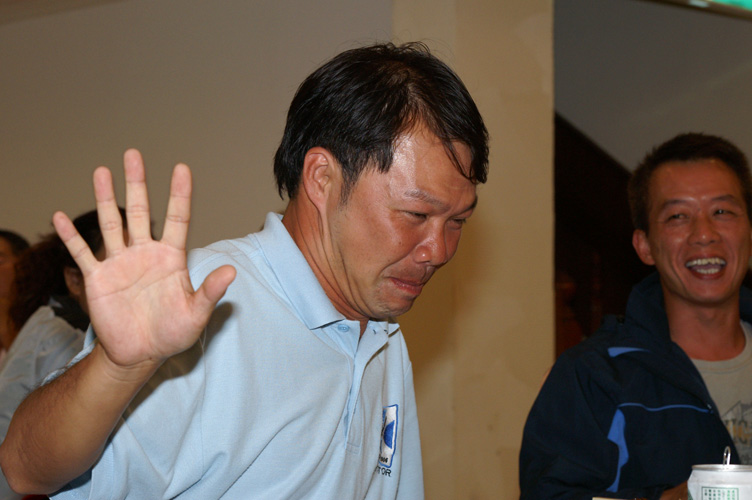
“No, no more . . .”
Richard’s turn!
See you in Typhoon Race 2009 ! |
||||||||||||||||||||||||||||||||||||||||||||||||
|
What did we do when back from the slope?
Fill the fridge with ammo . . .
We said the first wave of competition was at the slope and the second wave was in the rooms. Here is the battle field 309 – Fujimuro couple’s room! (Photo by Alex So)
(Photo by Alex So)
On day 3 the wind was too strong for competition. See Wan-Kin and you know how strong was it! (Photo by Wing Wong) <End> |